
Food & water · 07:15
Drip irrigation
Odds are the vegetables on your plate were grown with water delivered drop by drop, straight to the roots. The first practical dripper was built in a kibbutz in the Negev desert.
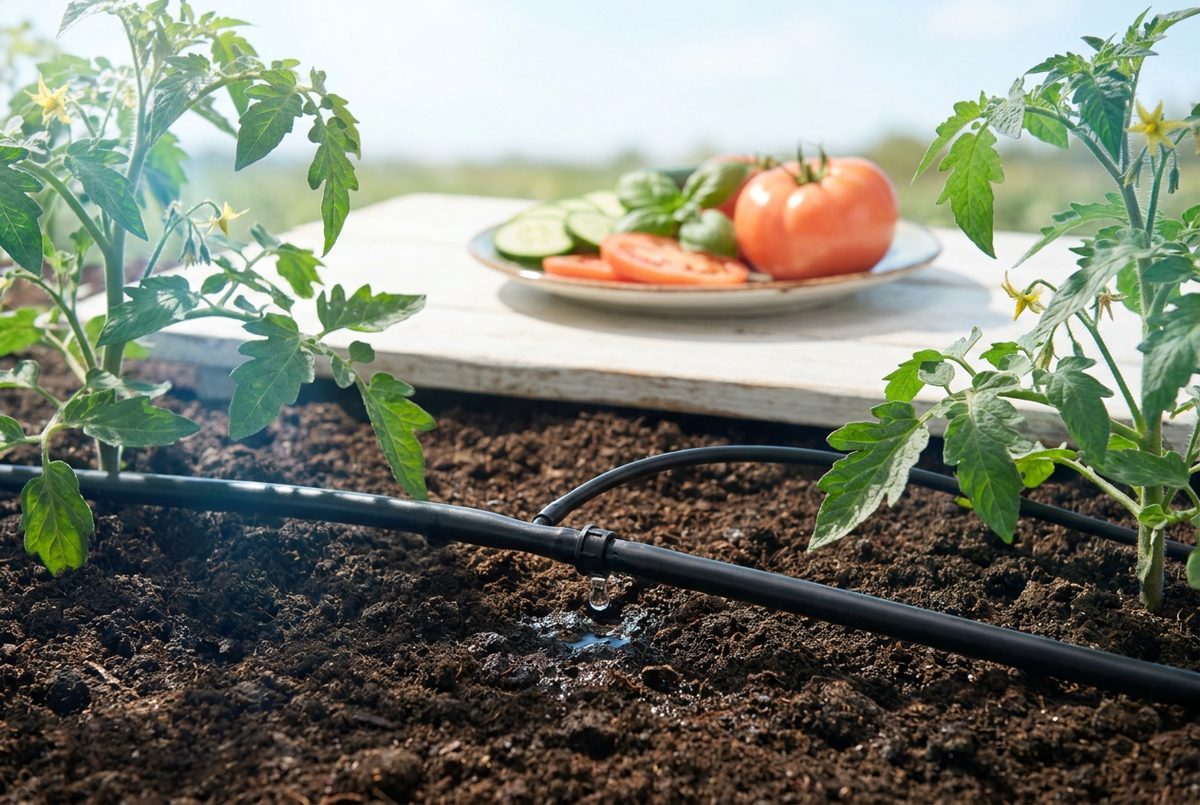
The everyday moment
A tomato needs a lot of water. Spray it over a field and much of it evaporates or runs off before it reaches a root. Drip it slowly into the soil next to each plant and almost all of it gets used. That simple shift is why farms in dry places can grow more food with less water, and why so many supermarket vegetables have a drip line somewhere in their story.
How it works
- Pipes along the rowsThin plastic pipes, called dripperlines, run along each row of plants, on the surface or buried just below it.
- A dripper at each plantBuilt into the pipe at set intervals are small emitters. Each one releases a slow, steady trickle instead of a spray.
- A long, winding pathThe trick in Simcha Blass's design was to slow the water with friction along a longer, wider channel inside the emitter, rather than squeezing it through a tiny hole that would clog.
- Water and food togetherFertiliser can be mixed into the water, so plants are fed exactly where their roots are. Modern systems add sensors and software to decide when and how much to water.
The Israeli story
Simcha Blass was born in Warsaw in 1897 and became one of the leading water engineers in the country, a co-founder of the national water company Mekorot and later a planner of the National Water Carrier.
In the early 1930s a farmer showed him a large tree that seemed to thrive without being watered. Blass found a leaking pipe joint nearby, wetting a small patch of soil. The water was spreading underground to that tree's roots. The idea stayed with him for decades.
It only became practical in the late 1950s, when cheap plastics arrived. Blass tested drippers between 1960 and 1965 and patented his design. In August 1965 he and his son signed a contract with Kibbutz Hatzerim, near Be'er Sheva, to found Netafim. Production began in 1966, and the company sold the world's first commercial dripper that year.
Where you meet it today
Netafim works in 110 countries with 19 factories and about 4,500 people, and holds roughly 30% of the world's drip irrigation market. Its systems water everything from Indian sugar cane to Rwandan farms, and it is working on low-pressure systems for farmers without strong water pressure or reliable electricity.
Did you know?
Netafim's name is Hebrew for 'drops'.